The Jasper Field Semester · Proposed curriculum

The Jasper Field Semester.
Proposed curriculum.

Six weeks in Jasper with a small group of six to eight adults. You leave with a stronger body, a freer mind and a life more closely examined.

06
weeks in person
144
facilitated learning hours
06–08
adult learners · ages 18+
03
proposed camping nights

01 / How the semester works

Four parts.
One connected education.

The curriculum has four layers. The courses run throughout the semester; the weekly theme gives them a shared question; the daily schedule determines what happens when; and the portfolio shows what each learner has understood and made.

  1. 01

    Six courses

    Six strands of learning, from fieldcraft and martial arts to science, philosophy and original inquiry.

  2. 02

    One weekly question

    Each week has a theme—Attention, Discipline, Evidence and more—that connects work across all six courses.

  3. 03

    Four teaching days a week

    Every week has four teaching days: one Day A, one Day B, one Day C and one Day D. Each letter is a different daily timetable that mixes several courses—not a separate course.

  4. 04

    Evidence of learning

    Keep weekly records, test ideas, revise work, build a capstone and explain your contribution individually.

In short: all six courses run across the six weeks. Each week’s theme connects them; each week has four teaching days, Day A to Day D, and each day’s timetable determines the mix of lessons. The six weekly portfolio entries are part of the evidence of learning, alongside the capstone and assessed demonstrations.

02 / The curriculum

Six courses.
144 hours in total.

Each course has a defined place in the weekly timetable and a distinct kind of work. The hours below are totals for the entire six-week semester—not hours per week.

CourseTotalWeekly rhythmMain evidence
JAS 101Fieldcraft, Hiking and CampingRoute-finding, preparation, field judgment and care.
36 hTwo fieldcraft sessions each week, on Day B and Day D.Evidence: A route-and-camp dossier; observed field judgment.
JAS 102Martial Arts and RestraintBalance, coordination, boundaries and controlled practice.
18 hTwo coached sessions each week, on Day A and Day C.Evidence: A coached control demonstration; practice record.
JAS 103Attention and Reflective PracticeNoticing, listening and reflecting on attention.
12 hA 15-minute attention practice every teaching day, plus a 60-minute seminar on Day C.Evidence: An attention-method comparison; personal protocol.
JAS 104Mathematics and Physics in NatureMeasurement, experiments, uncertainty and reasoned claims.
30 hTwo science sessions each week, on Day A and Day C.Evidence: A reproducible investigation; individual oral defence.
JAS 105Philosophy, Reading and ArgumentClose reading, dialogue, disagreement and revision.
30 hThree discussion sessions each week, across Day A, B and D.Evidence: Text annotations, a fair opposing argument and a revised essay.
JAS 106The Commons and Original InquiryCollaborative work that produces something useful to others.
18 hThree project sessions each week, across Day B, C and D.Evidence: A useful analogue artefact; stewardship and cost account.
Six course totals add up to the semester’s facilitated learning time.36 + 18 + 12 + 30 + 30 + 18 = 144 hours

The course codes describe this proposed introductory, non-credit design. Mathematics and Physics includes one chemistry investigation and one exercise in economic reasoning about choices and resources; the Commons also keeps an opportunity-cost account in Week 2.

03 / A teaching day

Four daily formats.
A steady rhythm.

There are four teaching days each week, and each one follows a different timetable: Day A, B, C or D. Every teaching day runs from 09:00 to 16:15. Select a day to see its course mix.

Day A / Model and practise

Build a method before testing it.

Science and coached physical practice sit alongside philosophical reading.

15 min

Attention practice JAS 103

A short daily exercise in noticing, listening or observation.

150 min

Mathematics and physics JAS 104

Investigate a question, make measurements and record evidence.

90 min

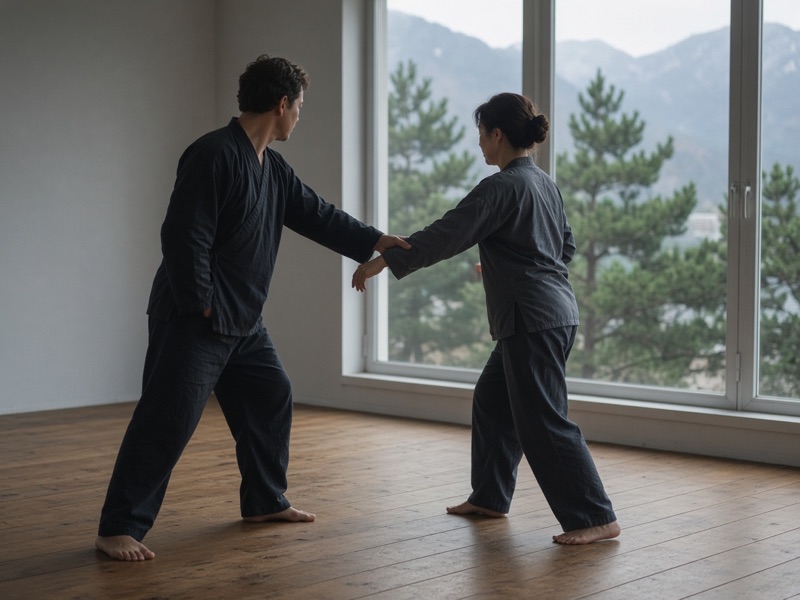
Martial arts and restraint JAS 102

Coached practice in balance, control, coordination and boundaries.

105 min

Philosophy, reading and argument JAS 105

Read closely, examine claims and test interpretations through discussion.

Facilitated learning360 min / 6 hours

Time in the day: 09:00–16:15 includes 6 hours of facilitated learning plus 75 minutes for meals and breaks. The complete instructor guide should be used for exact lesson timings and delivery instructions.

04 / The six-week journey

From attention
to contribution.

Each week has one central question. That question is not a seventh course: it is the thread connecting fieldwork, science, physical practice, reading and project work.

01
Week 01

Attention

What do I notice, and what do I merely assume?

In practice: Establish an observation baseline, read a local route, measure the same thing in more than one way, and begin close reading.

This week: Walk a local route. Measure the same object two ways. Read Plato and Laozi.

Where: Short local routes and the classroom

Evidence: Observation baseline; map-and-measure sheet; 250-word position.

Week 1 paper inquiry prompts →
02
Week 02

Discipline

When does restraint make us stronger?

One proposed camp night

In practice: Connect preparation and controlled practice with choices, effort and the costs of different options.

This week: First night at camp. Shelter, dry storage and shared chores. Read Aristotle and the Analects.

Where: A reserved, serviced campsite, one night

Evidence: First camp review; balanced practice plan; opportunity-cost account.

Week 2 paper inquiry prompts →
03
Week 03

Evidence

What would change my mind?

In practice: Repeat an investigation, track uncertainty and compare the result with the original prediction.

This week: Time a pendulum. Check the prediction. Measure a route against the map. Read Hume.

Where: Approved routes with observation stops

Evidence: Repeatable experiment; uncertainty record; revised claim.

Week 3 paper inquiry prompts →
04
Week 04

Freedom

What makes disagreement productive?

In practice: Represent a competing position fairly, audit a printed claim and choose a question for the capstone.

This week: Take turns as navigator. Debate Mill and Wollstonecraft. Study sampling and bias.

Where: On the trail and in the seminar room

Evidence: Structured debate; printed-claim audit; capstone proposal.

Week 4 paper inquiry prompts →
05
Week 05

Responsibility

What do I owe to a place and to other people?

Two proposed camp nights

In practice: Develop the capstone, test a prototype with another person and document its effects and limitations.

This week: Two nights at camp. Read Tagore and E. Pauline Johnson. Test the project with a peer or host.

Where: A reserved, serviced campsite, two nights

Evidence: Two-night camp dossier; prototype test; stewardship evidence.

Week 5 paper inquiry prompts →
06
Week 06

Contribution

What can I now explain, do and give?

In practice: Review how your observations and judgments have changed, finish the portfolio and explain your own contribution.

This week: Revisit a week-1 route. Run a small investigation. Present at the Jasper Commons Hearing.

Where: A comparable route and the classroom base

Evidence: Final portfolio; individual oral defence; 30-day commitment.

Week 6 paper inquiry prompts →

05 / Assessment and completion

Show your work.
Explain your thinking.

Assessment is based on records of learning, original work, practical demonstrations and an individual oral defence—not on physique, distance walked, combat dominance, personal beliefs or private spiritual experience.

What learners are expected to produce

The proposed assessment combines weekly work with a final project and demonstrations reviewed by instructors.

To complete the semester

Submit all six weekly entries and the capstone; reach at least level 2 in every dimension after revision; and demonstrate the required field and martial stop procedures to the responsible instructor. Missed sessions are made up through documented equivalent work.

What you receive

A descriptive, non-credit participation record. The programme does not award a degree, academic credit or professional credential.

01

Six weekly portfolio entries

Evidence from the weekly inquiry: observations, measurements, arguments, reflections and project records.

02

A capstone dossier

Document the question, evidence, decisions, testing, feedback and revisions behind an original piece of work.

03

An individual oral defence

Explain your reasoning, respond to questions and identify the limits of your conclusions.

04

Instructor-reviewed demonstrations

Show field judgment and safe, controlled martial practice within the programme’s agreed boundaries.

Five dimensions of assessment

A

Practice and care

Preparation, attention to safety and care for others.

B

Evidence and reasoning

Quality of observation, measurement, inference and uncertainty.

C

Interpretation and argument

Close reading, fair representation of alternatives and reasoned claims.

D

Original work and revision

Making, testing, receiving feedback and improving the work.

E

Contribution and autonomy

Keeping agreed commitments, respecting consent and dissent, and creating fair conditions for others to contribute.

Each dimension is scored from 0 to 3. Descriptive feedback is given in Week 3 and a revision opportunity in Week 6. Adapted tasks are assessed against the same standards.

06 / Practical information

Know the rhythm.
Know the conditions.

This is a small, in-person, mostly offline programme with substantial field activity. Its timetable, camp arrangements and participation conditions need to be understood before enrolment.

Format and daily hours

Four teaching days a week

Six weeks in person, for adults aged 18 and over, in a proposed cohort of 6–8 learners. Each teaching day runs 09:00–16:15, with 360 facilitated learning minutes and 75 minutes for meals and breaks. The other three days of the week carry no compulsory training.

Camping

Three proposed nights

Week 2 includes one night; Week 5 includes two nights, with Saturday checkout and return. During camping weeks, the schedule is A on Tuesday, C on Wednesday, B on Thursday and D on Friday. Camp meals, sleep, transport and duty sit outside the 144 teaching hours.

Learners who do not stay overnight can use an accessible sleeping arrangement or a supervised day-camp equivalent, with the same educational standing.

Offline learning

Paper, people and direct experience

Personal phones and networked devices are off during learning and camps. The core includes no internet or live AI. Learners retain switched-off devices or may choose secure storage; devices are returned on request. Staff retain emergency communications and check current conditions.

Private medical, accessibility and essential-contact exceptions are agreed in advance. The wider university may use AI; the core semester uses instructor-written printed claim cards, with any optional connected audit outside the 144-hour core.

Read the participation arrangements →

Winter break

Mid-December to mid-February

The winter break lasts approximately two months, with no required teaching or camping. Six-week cohorts finish before the break or begin after it. Exact dates are confirmed each academic year.

Proposed programme

Before enrolment can open, qualified local staff, a host, venues, equipment, permissions, insurance, accessibility arrangements and funding must be confirmed. Dates, fees, subsidies and included costs are not yet confirmed. No degree, academic credit or professional credential is offered. The founder’s personal spending limit is separate from the actual cost of delivery.

07 / Complete materials

Go deeper
into the teaching plan.

The page explains the semester at a glance. The full documents contain the lesson-by-lesson material and reusable paper exercises.

Enrolment is not open while the programme’s staffing, host, venue, permissions, insurance and funding remain unconfirmed. You can prepare an application now and keep it until an official channel opens.

08 / Teaching examples

How a real question
is taught across the courses.

These are teaching examples from the instructor guide, not extra courses or extra hours. Each one takes an everyday question and works on it inside the existing timetable, so the six courses build one piece of work together.

The Jasper method in four steps

Every example follows the same pattern. A learner meets the question in practice, tests it with evidence, asks why it matters, and turns it into something another person can use.

  1. 01

    Experience it

    Fieldcraft, martial arts or attention

    Meet the question in practice first: on a route, in a drill or in a short reflection.

  2. 02

    Test it

    Mathematics and physics

    Turn a hunch into a prediction, then measure, repeat and record how certain the result is.

  3. 03

    Question it

    Philosophy

    Read and debate why it matters, and state the strongest case against your own view.

  4. 04

    Make it useful

    The Commons

    Turn what you learned into something another person can use, ask them to try it, then revise it.

Three example questions

Example 01 / Warmth

What does it take to keep someone warm?

A cold morning becomes a question about physics, preparation and our obligations to one another.

01Experience it

Fieldcraft

Plan clothing layers and shelter for an approved outing. Testing uses warm water and materials indoors; nobody is exposed to cold as an experiment.

02Test it

Mathematics and physics

Compare cooling curves, repeat the measurements and explain the uncertainty. Separate the effect of an insulating material from changes in starting temperature.

03Question it

Philosophy

Read an argument about voluntary hardship. Defend a distinction between a worthwhile challenge and avoidable harm.

04Make it useful

The Commons

Build a paper packing guide. Ask a peer to use it, record what they misunderstand and revise it.

What the learner leaves withA graph, a reasoned argument, a tested guide and a decision you changed.

These are proposed examples. The instructor guide sets the exact contexts once local conditions, access and the actual group are known, and every activity stays within agreed safety boundaries. Read the examples in the instructor guide ↗ (PDF, opens in a new tab)